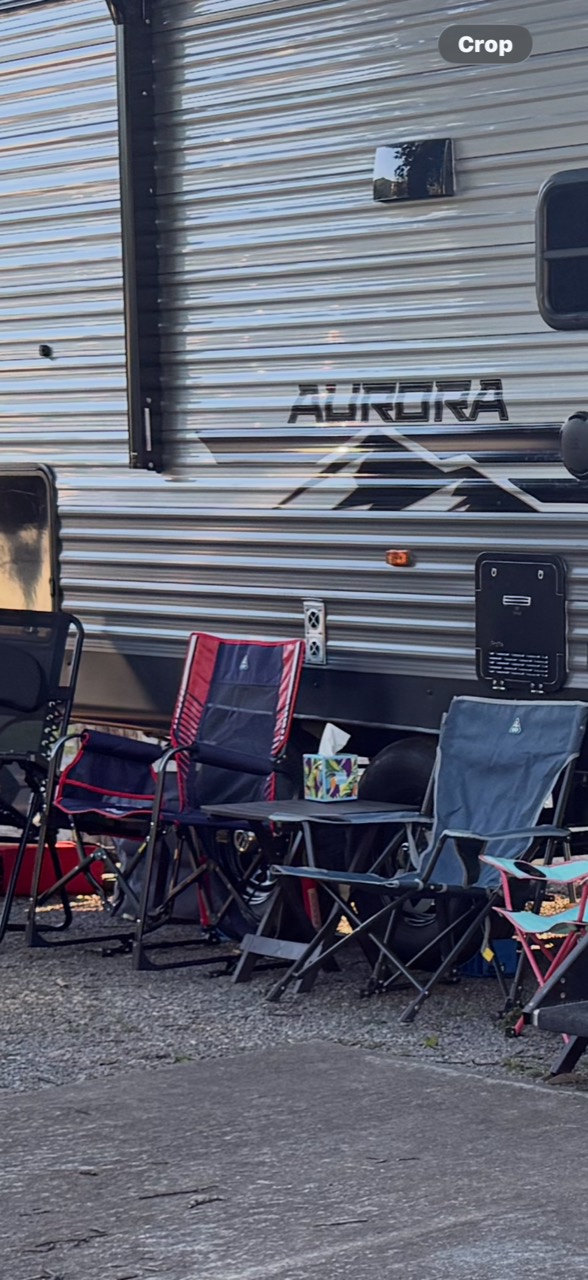
Could a truck get a bigger camper moving? Maybe. That is not the question we want to answer with our family in the seats.

For us, camping means taking our daughter and two dogs along for the adventure. The goal is not to win a parking-lot argument about who can pull more. It is to choose a setup we can load responsibly, stop, steer, and bring home again.
This is the longer companion to our towing video. You do not need to memorize a pile of initials before you shop. You do need to know where the limits come from—and leave room for the way your family actually camps.
Start at the door sticker, not the biggest number in the ad
Two trucks with the same badge can have different limits. Engine, axle ratio, cab, bed, drive system, equipment and options matter. Use the towing information for your actual configuration, plus the labels on your truck and camper. A dealer’s “you’ll be fine” is not a weight ticket. [1]
| Number | Plain-English meaning | Where to check |
|---|---|---|
| Payload | What the truck can carry: people, dogs, gear, added equipment and hitch/tongue load. | Truck’s occupants-and-cargo label |
| GVWR | Maximum loaded weight of one vehicle. Truck and trailer each have their own. | Each vehicle’s certification label |
| GAWR | Maximum load on an axle. A total under GVWR can still hide an overloaded rear axle. | Axle ratings on vehicle labels |
| GCWR | Maximum combined weight of the loaded truck and loaded trailer. | Manufacturer information for your truck |
| Tow rating | Maximum loaded trailer weight under the manufacturer’s stated conditions. | Exact configuration’s towing guide |
| Hitch limits | Limits for total trailer weight and downward tongue load, in the applicable hitch mode. | Vehicle and every hitch component |
Check all of them; the worksheet does not pick one convenient number and ignore the others. [1]
The truck carries more than the cooler
Think about an ordinary departure morning: the family climbs in, the dogs settle down, the cooler goes in, and someone remembers another bag. None of that is unusual. It all belongs in the plan.
Made-up example: Start with 1,700 lb of payload. Subtract 500 lb of people, 80 lb of dogs, 180 lb of gear/accessories, 100 lb of hitch equipment and 100 lb of extra packing allowance. That leaves 740 lb for estimated tongue load. A 6,000 lb loaded camper at a hypothetical 13% tongue load contributes 780 lb—40 lb beyond that allowance, even if its total weight is below the truck’s tow rating.
The lesson is not that every 6,000 lb camper is too much. It is that the family and equipment going in your truck change the answer.
Your camper does not travel at brochure weight
Unloaded weight is a starting point, not a promise about the packed camper. Forest River describes cargo capacity as space in the weight allowance for water, cargo, and additional equipment. Read what your unit’s starting weight already includes before adding batteries, propane or accessories again. [2]
Bins make gear easier to find; they do not make it lighter. Hoses, extension cords, the griddle, chairs, tools, clothes and dog supplies deserve a place on the list. We would rather put an honest allowance in the worksheet than pretend the last few bags weigh nothing.
Traveling with less fresh water can reduce the load, but “just travel empty” is not a fix for every mismatch. Know whether potable water is available when you arrive, carry what your trip requires within the ratings, and follow the tank/support instructions. Check the return trip too: fresh water used in the camper may now be in gray or black tanks, and a refill can add more.
Tank location matters. Water near the front, over the axles, or behind them can affect tongue load differently. The worksheet compares total weight; it cannot predict that shift. Recheck actual tongue and axle weights when the load changes.
Your numbers, your trip
The “before we hook up” worksheet
Grab the door stickers, trailer label, hitch instructions, and a pencil—or use the boxes below. This is a planning estimate, not permission to tow. It cannot tell how your rig will handle, brake, or distribute weight between individual tires.
For conventional, ball-coupled travel trailers only—not fifth wheels, goosenecks, motorhomes, or commercial combinations. Use pounds and US gallons. Unknown ratings should stay blank. Zero means you have checked and there is none.
Enter your trailer starting weight to begin. Blank limits will remain “Not assessed.”
How the worksheet does the math
Camper estimate = starting weight + missing dry-mode items + extra camper allowance + water. Truck payload estimate = people + pets + truck gear + later accessories + hitch equipment + extra truck allowance + estimated tongue load. Truck GVWR estimate = truck-alone scale weight + extra truck allowance + estimated tongue. Combined estimate = truck-alone scale weight + extra truck allowance + total camper estimate. Tongue is already part of the camper total and is not added again to combined weight.
These are conservative, pre-weight-distribution truck estimates—not predictions of axle loads with spring bars engaged. The tool gives no credit for weight redistribution. Actual loaded axle readings, front-axle restoration, tire limits and equipment instructions still control. Water location may change tongue load in ways a fixed percentage cannot model. “Headroom” means only arithmetic below an entered rating, not a safety endorsement.
A good hitch helps. It does not turn the truck into a bigger truck.

A weight-distribution hitch shifts how the tongue load is carried across the axles. It does not erase weight or increase the vehicle’s weight ratings. Spring bars and sway control are not permission to overload anything.
Choose and adjust the hitch for the loaded combination, using both truck and hitch instructions. Some hitch sizing procedures also account for cargo behind the truck’s rear axle. Do not copy someone else’s washer count, bracket position or torque setting from a photo. [4] [5]
For conventional trailers, 10–15% is a common tongue-weight planning range, but the applicable manufacturer requirements come first. Too little or too much can create problems. The percentage on our worksheet is an estimate—not a measurement, and not a reason to push cargo to the back until a warning disappears. [1]
The scale visit that replaces guessing
Pack for the trip you actually take. Include the people, dogs, fuel, hitch, food, gear and chosen water load. Keep a note of what was aboard so the numbers mean something next time.
- Ask the scale operator where to go. CAT’s truck-and-trailer layout puts the truck’s front axle on one platform, rear axle on the next, and trailer axles on another.
- Get the road-ready combination weighed. Compare the front and rear axle readings with their respective ratings, the truck axle sum with truck GVWR, and the full sum with GCWR.
- Do not call the trailer-axle line the whole trailer. Part of the trailer load is carried through the hitch. A truck-alone baseline and an appropriate weighing procedure are needed to establish total trailer weight; tongue measurement needs its own correct procedure.
- Take the ticket and labels to someone qualified if you need help. CAT gives axle-group weights, not individual tire/corner weights. Passing a group total does not prove that every tire or individual trailer axle is within its limit.
Use the operator’s approved area for any unhitching or adjustments. Do not disconnect spring bars and drive an overloaded weight-carrying setup just to get another number. Follow a procedure compatible with your equipment limits. [6]
With an unchanged truck baseline and a complete combination weight, trailer total = combination total − truck-alone total. Do not add tongue weight again. To measure actual tongue weight, use suitable equipment or a qualified weighing service; the rear-axle increase with weight distribution engaged is not the tongue weight.
Below the limits is the beginning—not the whole safety check
Tires and brakes still have work to do
Check cold tire pressure using the applicable vehicle/trailer placard and tire guidance. The maximum number molded on a sidewall is not automatically the correct pressure for every vehicle. Look for damage and aging, confirm load capacity, and include the spare in your routine. A pressure-monitoring system does not replace inspection. [7]
Keep the load where it belongs
Secure cargo so it cannot move around or leave the trailer. Keep heavier items low and near the axles where practical while maintaining the required tongue load. A rear rack full of heavy gear is not a clever way to make tongue weight disappear; check rack/frame limits and the whole weight distribution. [8]
Give the drive some breathing room
Allow more stopping distance, slow before curves, and set up trailer brakes according to the instructions. Use Tow/Haul or grade assistance if your truck provides it and its manual recommends it. Control speed before a descent and use the appropriate gear/engine braking rather than riding the brakes. Weather, crosswinds, road surface and fatigue can make postponing the trip the better choice. There is no universal brake-controller number or downhill speed we can give you here. [9]
If the setup feels unstable, do not keep testing it at highway speed. Slow and stop safely as conditions allow, investigate the cause, and get help. Staying under a handful of weight numbers does not certify the combination’s handling.
One more walk around
The travel-day checklist
Check each item after you verify it—not because a worksheet number looks encouraging. Print this page to take the checklist and your filled-in numbers along.
Want the fuller departure routine? Open our departure walkaround.
Watch the short version. Keep this page for the homework.
Our original, real-footage video covers the big questions in under three minutes. The worksheet and sources here are the next step—not a replacement for your owner’s manual.
Watch on YouTube Watch on TikTok
Find us on Instagram · Follow on Facebook
No autoplay and no video-player tracking loaded on this page. The links open the social platforms.
A few questions we would ask before buying
Can I just use an “80% rule”?
You can choose extra room in your planning, but a single percentage is not a universal manufacturer safety rule. It cannot replace payload, axle, tire, receiver and combined-weight checks. Our extra-packing boxes are added pounds—not a certified safety factor.
Do air bags or a bigger hitch raise my ratings?
Do not assume a leveling aid or higher-rated accessory changes vehicle certification limits. Have the manufacturer or a qualified professional explain what your equipment does, and use the applicable vehicle ratings.
What if I am shopping and cannot weigh the camper yet?
Use the specific unit’s labels, build an honest load estimate, and consider whether your truck can accommodate a camper near its allowed loaded weight. Make access to labels and a loaded-weight verification plan part of the purchase discussion. Do not treat a blank box as a pass.
Does this page prove our F-150 and Aurora are within every limit?
No. We are showing our equipment, not publishing a verified scale analysis of our own combination. Your model, equipment, labels, loading and conditions may differ. The sample numbers are fictional.
Where we checked the details
Research checked September 26, 2026. We used manufacturer and public-safety sources rather than towing-capacity claims from social comments. Follow the instructions for your exact equipment if a general guide differs.
- Ford towing guides — Definitions, configuration-specific limits, and tongue-load planning. Select your own model year.
- Forest River Aurora weight definitions — UVW, cargo capacity, and water. Brochure numbers are not a substitute for your trailer label.
- Forest River owner manuals — Find the manual and component instructions for your actual RV.
- Equal-i-zer: common hitch questions — Loaded tongue weight and equipment-specific hitch sizing. Not every hitch follows the same procedure.
- Equal-i-zer: selecting a hitch size — Why loaded weight matters more than a dry-weight sales number.
- CAT Scale: how to weigh — Platform placement and the limits of axle-group measurements.
- NHTSA: tire safety — Cold pressure, labels, condition, and tire checks.
- NHTSA: secure your load — Secure cargo and avoid overloading.
- Ford: essential towing checks — A manufacturer reference for towing checks and driving precautions; your own vehicle manual controls.