Jump to a section
Campground power · our 30-amp setup
What an expensive dogbone protects—and where its limits begin.
Campground electricity is one of those things you cannot judge by looking at the pedestal. Our Hughes Power Watchdog gives us surge protection, wiring diagnostics, and Bluetooth monitoring before that power reaches our 2026 Aurora Light 26BHS.
The short version
An expensive safeguard for a much more expensive camper.
We bought our 30-amp Hughes Autoformers Power Watchdog when we purchased the Aurora from Blue Compass RV. It was not the most exciting accessory in the pile, and it certainly was not the cheapest. But it protects and monitors the electrical connection feeding the air conditioner, refrigerator, converter, television, outlets, and everything else inside the camper.
We can replace a surge protector. We would rather not start replacing camper electronics because a pedestal had a problem we could not see.

Campground power can misbehave just like campground water.
Most RV owners learn quickly not to connect an unknown water source without thinking about pressure. Too much water pressure can find a weak fitting, damage a hose, or turn a small plumbing issue into a wet camper.
Electricity deserves the same respect. A campground may have dozens or hundreds of sites sharing infrastructure. Pedestals live outside through heat, rain, freezing weather, insects, repeated plugging and unplugging, and years of use. Wiring can be damaged, a connection can loosen, polarity can be wrong, a neutral or ground can be missing, and voltage can change as the campground load rises and falls.
That does not mean every campground has bad power. It means a clean-looking pedestal cannot tell us everything happening behind it.
Our particular model
Hughes Power Watchdog PWD30.
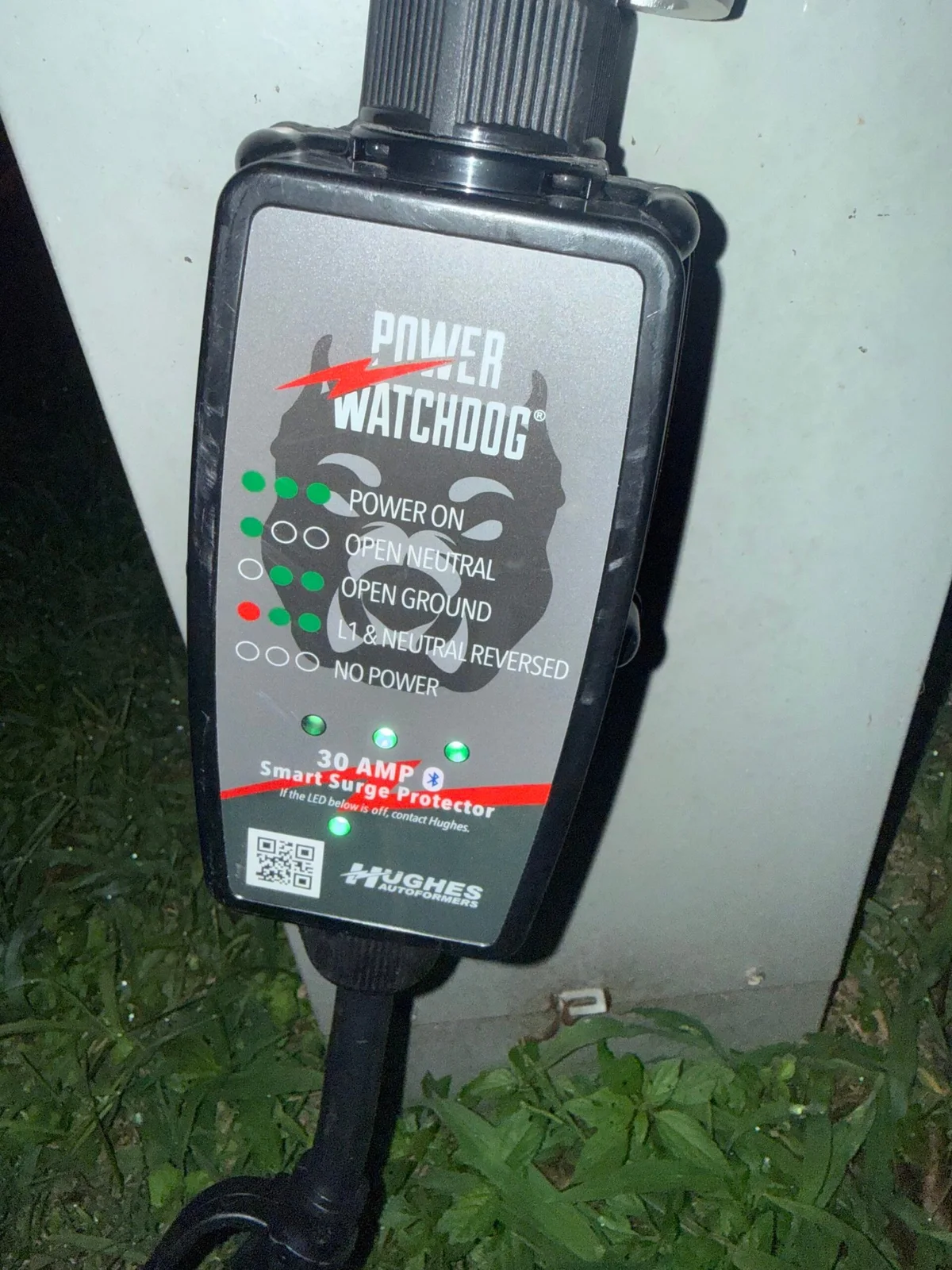
Our camper uses 30-amp service, so our portable unit is the 30-amp Bluetooth model identified by Hughes as the PWD30. According to Hughes, it provides approximately 3,000 joules of surge protection, an IP65 weather-resistance rating, front-panel park-power diagnostics, a replaceable surge module, and Bluetooth monitoring through the Power Watchdog app.
The LEDs can identify power status and common pedestal faults such as an open neutral, open ground, or reversed line and neutral. In the app, we can watch voltage, amperage, and wattage in real time and set alert thresholds.

What it helps us catch
There is more to shore power than a dramatic lightning strike.
A surge protector should not be treated as protection from a direct lightning strike. It is protection against the more realistic surges, spikes, and wiring problems that can occur in an electrical system. When severe weather is close, the safest answer may still be to disconnect from shore power if it can be done safely.
The part designed to take the hit
The replaceable surge module is sacrificial on purpose.
Surge protection is not an invisible shield that lasts forever. Inside the Power Watchdog is a replaceable surge module—sometimes casually called the surge board—that absorbs excess electrical energy. A strong event or repeated smaller events can use up that protection.
That is not the module failing at its job. Sacrificing itself is the job. The advantage of this design is that we can replace the surge module instead of discarding the entire Power Watchdog.
The unit and app can indicate when the surge-protection capacity has been used up. If that happens, we stop treating the unit as protected, disconnect safely, confirm the correct replacement module for the exact model, and follow Hughes’ instructions. We also investigate the event rather than simply installing a new module and reconnecting to the same questionable pedestal.
Why the price makes sense to us
We are paying for the device that gets sacrificed first.
A Power Watchdog costs much more than a simple plug adapter. The way we look at it, the cost is buying a diagnostic check at every pedestal, surge absorption, live information on the phone, and a replaceable component intended to take damage before the camper does.
It cannot prevent every electrical failure, but it can turn some invisible problems into warnings before they become expensive lessons.
Why we recommend the Bluetooth model
The app makes the numbers useful.
Front-panel lights are useful during setup, but Bluetooth means we do not have to stand at the pedestal to see what the camper is drawing. The Power Watchdog app can show voltage, amperage, wattage, and energy use while we are inside the camper or around the campsite.
That is especially helpful when the air conditioner starts, when several appliances are running, or when campground demand changes later in the day. Hughes describes typical real-world Bluetooth range for this generation as roughly 30 to 50 feet, depending on obstructions and the phone. Bluetooth monitoring does not require a subscription or cellular service, but the phone must remain within range.

Our campsite hookup order
We let the Power Watchdog inspect the pedestal before the camper does.
- Leave the camper disconnected. We begin with the pedestal breaker off and the RV cord unplugged.
- Look at the pedestal. We check for obvious heat damage, broken receptacles, loose parts, water intrusion, or anything else that makes the connection look unsafe. We do not open or repair campground electrical equipment.
- Connect the Power Watchdog. The Watchdog plugs into the pedestal before the RV cord.
- Turn on the pedestal breaker. We read the LEDs and give the unit time to analyze the connection. If it reports a fault, the camper stays disconnected and we contact campground staff.
- Secure the locking ring. Because these units are expensive and sit outside in plain view, we run an appropriately sized cable lock or padlock through the built-in security ring and secure it to the pedestal where the campground permits it. The lock should not obstruct the breaker, receptacles, neighboring connections, or staff access.
- Connect the RV cord only after the check looks good. Then we confirm the connection in the Bluetooth app.
- Watch the loaded reading. Voltage with very little running is only part of the story. We pay attention when the air conditioner and other meaningful loads come on.
- Disconnect in reverse. When breaking camp, we turn off the pedestal breaker before unplugging and remove the lock without leaving anything behind.
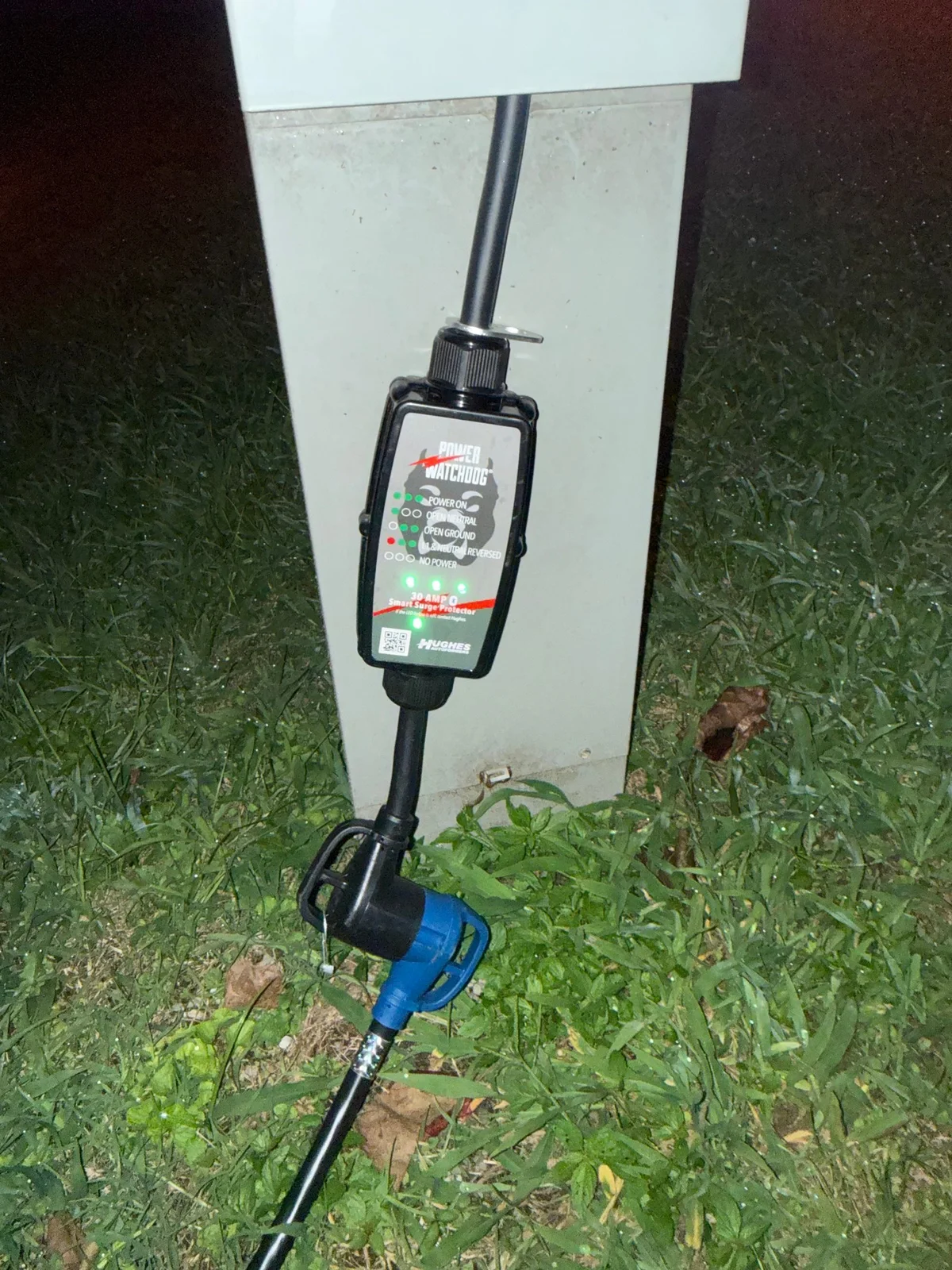
The lock is a deterrent, not a guarantee.
A cable lock will not make the Power Watchdog impossible to steal, but it removes the easy opportunity to unplug an expensive accessory and walk away. We choose a lock that fits the ring without stressing the electrical cable, keep the unit and connections supported off the ground, and follow campground rules. We never wrap a lock around equipment in a way that prevents an emergency disconnect.
Know which protection you are buying
The base PWD30, EPO model, and a voltage booster are not interchangeable.
If we were buying specifically for automatic high- and low-voltage shutdown, we would compare the PWD30-EPO or the current equivalent—not assume that every product carrying the Power Watchdog name performs the same function.
Where to find one
Buy by the exact model number, not just the dog logo.
We purchased ours directly from Blue Compass RV when we bought the camper. The PWD30 and related Power Watchdog models may also be available from Hughes Autoformers, Camping World, Amazon, independent RV dealers, and local RV-parts providers.
Prices and inventory change. Before ordering, confirm whether the listing is the base PWD30, an EPO model with automatic shutdown, a newer Wi-Fi generation, or a 50-amp version. Also check the seller, return policy, warranty eligibility, and availability of the correct replacement surge module.
A few practical answers
Power Watchdog questions we would ask before buying.
Does the PWD30 make bad voltage good?
No. It monitors voltage and can alert us, but the base PWD30 does not regulate, boost, or automatically disconnect for voltage outside our chosen alert range.
Can we ignore a fault because the camper still has power?
No. A warning is a reason to keep the camper disconnected, turn off the breaker when safe, and ask campground staff to inspect the pedestal or move us to another site.
Does the replaceable module mean the whole unit lasts forever?
No electrical product lasts forever. The replaceable module means a used-up surge component may be replaced without discarding the entire unit, provided the rest of the unit is undamaged and the manufacturer says it is safe to return to service.
Do we need it at a newer campground?
We use it at every campground. New equipment can still be wired incorrectly, damaged, overloaded, or affected by a fault elsewhere in the system.
Can we use adapters?
Hughes lists the PWD30 as compatible with dogbone adapters, but an adapter does not increase the camper’s 30-amp capacity. Every connection still needs to be correctly rated, supported, and used according to its instructions.
Our recommendation
We would rather inspect campground power with a replaceable device than test it with the camper.
The PWD30 has earned a place in our setup because it makes invisible electrical conditions visible. We like the diagnostics, the Bluetooth readings, the replaceable sacrificial surge module, and the locking ring that lets us discourage an easy theft.
It is not complete protection from every electrical problem, and it is not a voltage regulator. It is one useful layer between an unfamiliar pedestal and a camper full of equipment we would rather keep working.
Sources checked: Hughes Autoformers/Power Watchdog product information and support guidance; Camping World PWD30 listing. Last reviewed August 2026.