
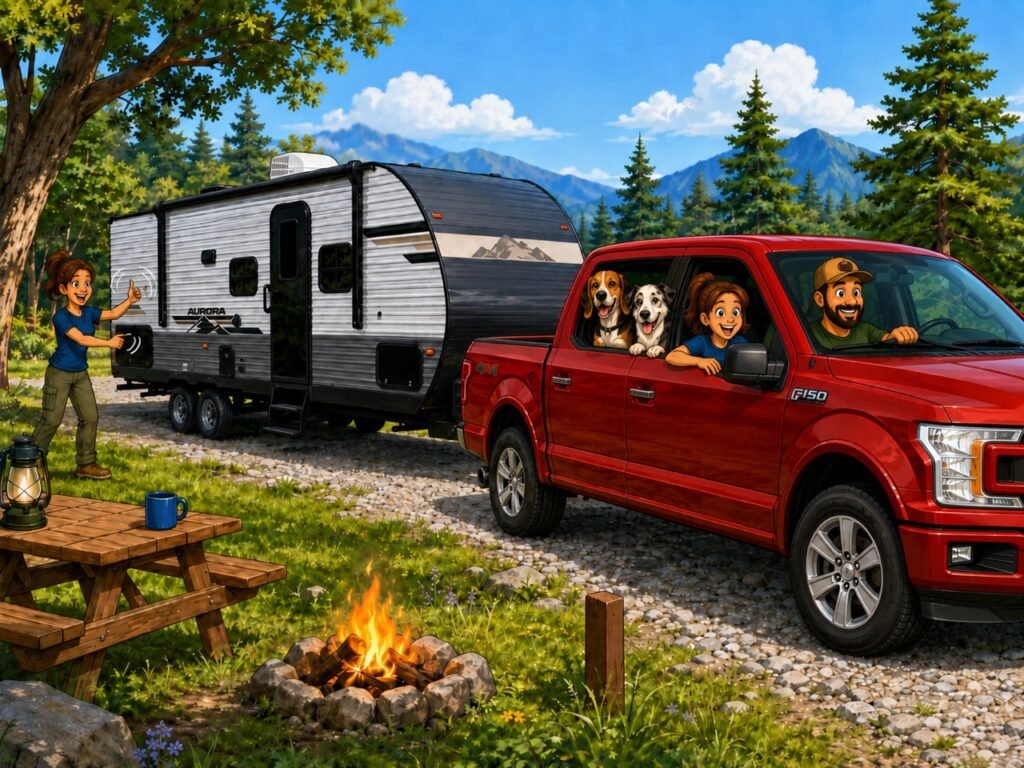
Backing a travel trailer can turn two reasonable adults into people who suddenly cannot agree on what “this way” means.
From the driver’s seat, I may see one hand appear in a mirror for half a second. Sami may believe she is giving a perfectly clear direction. Lily is usually watching the entire performance, and Happy and Dolly contribute exactly zero useful information from the back seat.
Our arrivals became calmer when we stopped treating backing as a test of talent and started treating it as a short team procedure. We walk the site, choose one adult spotter, agree on a few words and signals, and stop whenever either person is unsure.
Our nonnegotiable rule: If the driver cannot see the spotter, the driver stops.
This article describes the process that works for our family. It is general experience, not a replacement for the instructions, cameras, mirrors, safety systems, campground rules, or professional training that apply to your exact tow vehicle and trailer.
Why backing becomes a communication problem
The driver and spotter are looking at two different versions of the same campsite.
The spotter can see the tree near the rear corner, the picnic table beside the steps, and the utility pedestal the trailer needs to reach. The driver sees mirrors, part of the trailer, changing angles, and whatever a camera happens to show. Neither person has the whole picture.
That is why vague directions fall apart. “Come toward me” may make sense to the person standing outside, but it does not tell the driver which way to steer or whether the instruction refers to the truck or trailer.
The goal is not to create a complicated set of campground hand signals. The goal is to remove interpretation.
Step 1: Walk the campsite before the truck goes into reverse
We park where we are not blocking traffic, put the truck in park, and walk the site together when conditions allow.
We look for:
- the final position of the trailer tires;
- the likely low side of the campsite;
- trees, posts, branches, drop-offs, soft ground, roots, and fire rings;
- room for the slide, awning, steps, and exterior storage doors;
- electrical, water, and sewer locations;
- a safe place for Sami to stand where I can see her;
- a reasonable approach angle from the campground road; and
- children, pets, bicycles, golf carts, and neighboring vehicles that may move through the area.
We do not move campground equipment without permission. If a site cannot safely or reasonably fit our camper, we stop and talk with campground staff instead of forcing the setup.
Step 2: Choose one adult spotter
Only one person guides the driver. Helpful neighbors can wait until the truck is in park.
For our family, the spotter is an adult. Lily stays secured in the truck or in another safe location under direct adult supervision, and the dogs remain secured. A child should never be responsible for guiding a moving tow vehicle and trailer.
Before moving, we agree on three things:
- where the trailer should finish;
- where the spotter will stand and move; and
- what communication method we will use.
If we use phones or walkie-talkies, we connect them before the truck moves. We do not begin backing and then try to solve a connection problem halfway into the site.
Step 3: Use words that identify the direction
We avoid “this way,” “that way,” and “come toward me.” Instead, we use a few short directions that mean the same thing every time.
| Unclear direction | Clearer direction |
|---|---|
| “Come this way” | “Trailer toward driver side” |
| “Turn it” | “Steer driver side” |
| “You are good” | “Continue straight—three feet” |
| “Watch out” | “Stop” |
| “A little more” | “One foot, then stop” |
Driver side and passenger side are usually easier to understand than left and right because the meaning does not change when the spotter turns around.
We also agree that stop means stop now. It is not a criticism, and it does not require an explanation before the brakes are applied.
Step 4: Keep the spotter visible and outside the travel path
The spotter stays in a position where the driver can see them directly or in an agreed mirror. The spotter does not stand directly behind the moving trailer, between the trailer and a fixed object, or anywhere the truck or trailer could move toward them.
If Sami disappears from the mirror, I stop. If she needs to cross to the other side, I stop and wait until she is visible again. If either of us becomes unsure, we stop, put the truck in park, and walk the site again.
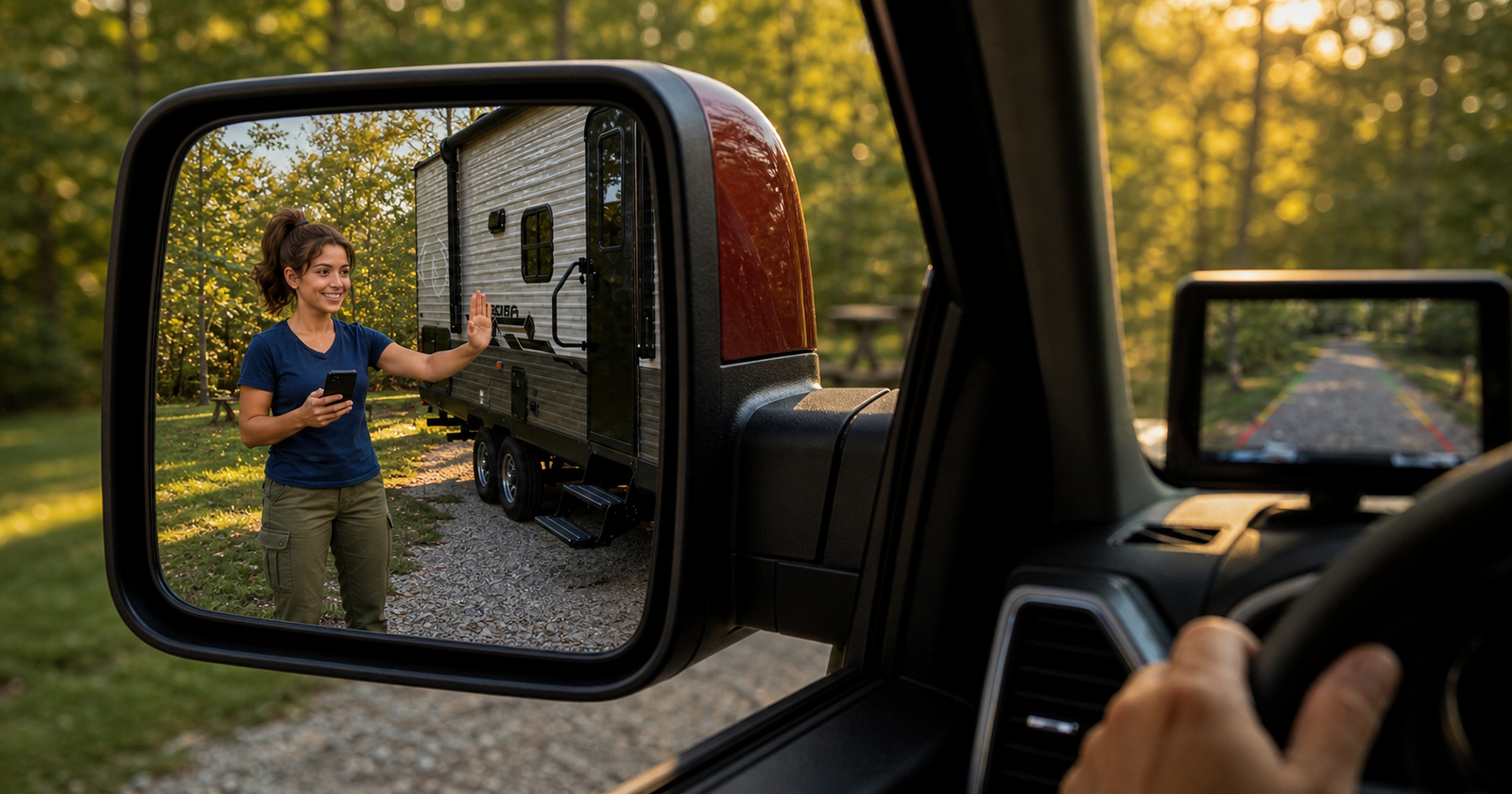
Illustration: the driver needs a clear, agreed view of the spotter. Exact mirror coverage varies by vehicle and trailer.
Step 5: Let cameras support the spotter—not replace the plan
A truck camera can help with the hitch or the truck’s immediate path. A trailer camera can help the driver understand what is behind the camper. Mirrors show other important angles. None of them automatically show every tree, post, child, pet, low branch, or corner.
We use cameras as another view, not as permission to ignore the spotter or stop rule. If the camera image, mirror view, and spotter direction do not agree, we stop and look.
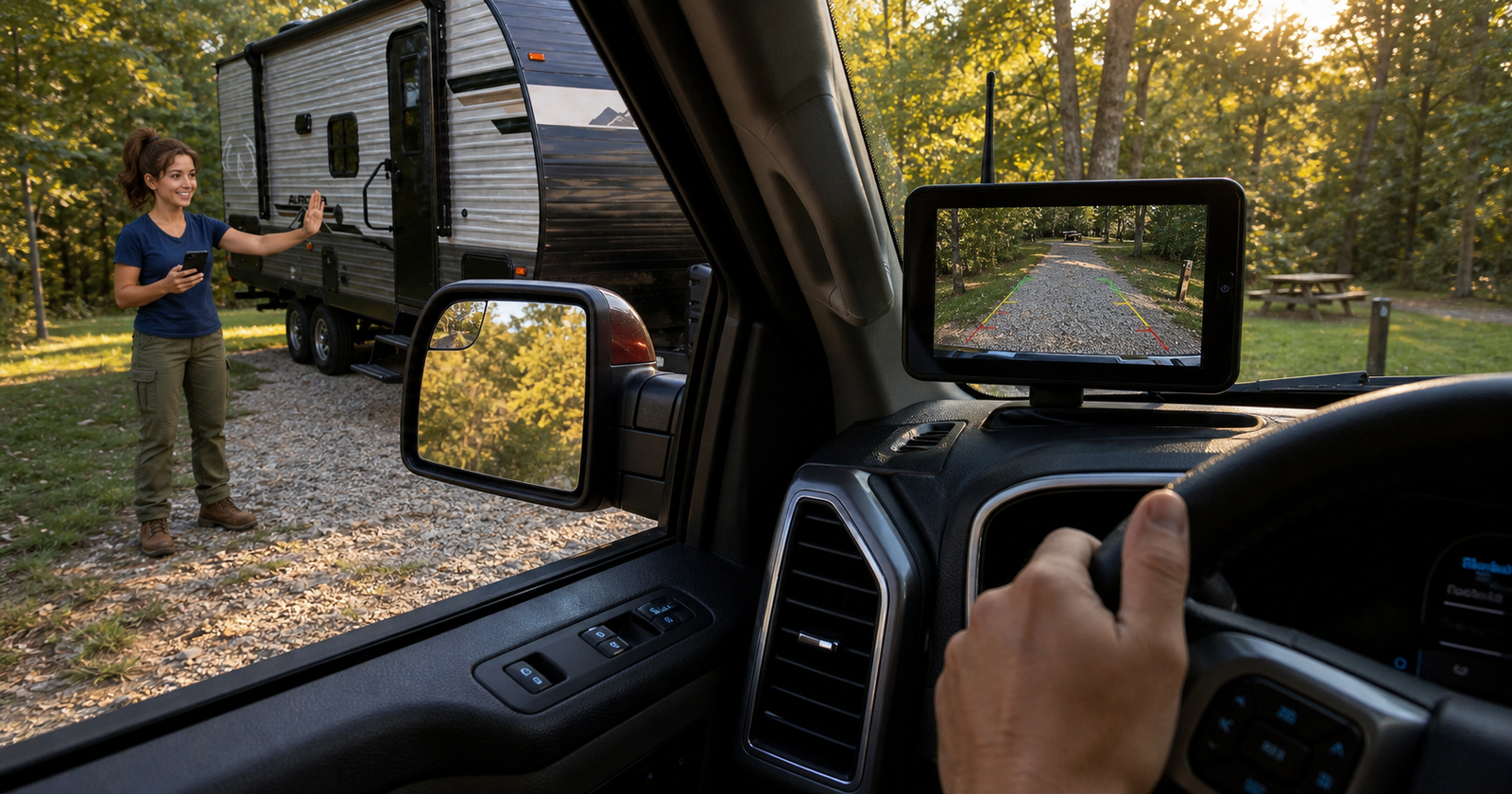
Illustration: cameras add information, but the driver remains responsible for controlling the vehicle and verifying the path.
Step 6: Make one small correction at a time
Large corrections create new problems quickly. We back slowly, pause often, and make small steering changes. When the angle stops making sense, pulling forward and resetting is usually calmer than trying to rescue a poor approach in reverse.
Taking three attempts is not a failure. Hitting a post because we were embarrassed to pull forward would be a much worse story.
The spotter watches more than the rear bumper. They keep checking:
- both rear corners;
- trailer tires and wheel path;
- the front swing of the trailer;
- the truck’s front corners;
- overhead clearance;
- the campsite edge and neighboring property; and
- people or animals entering the area.
The driver still checks mirrors and cameras and remains responsible for stopping the vehicle.
Step 7: Put the truck in park before changing the plan
If we need a longer conversation, the truck goes into park. We do not try to debate the geometry while the rig is rolling.
This single habit helps the tone of the conversation. It changes the moment from “Why are you not doing what I said?” to “Let’s look at where the tires need to finish.”
Our simple arrival script
This is the short version we can use even after a long travel day:
- Walk: Check the site and choose the trailer’s final position.
- Assign: One adult spotter; child and dogs secured.
- Agree: Choose the mirror, words, signals, and stop rule.
- Back slowly: Make one small correction at a time.
- Stop when unsure: Lost sight, unclear direction, moving obstacle, or bad angle.
- Reset if needed: Pull forward, park, walk, and try again.
- Finish safely: Once positioned, follow the trailer instructions for chocking, leveling, and unhitching.
What usually starts the argument
Giving two directions at once
“Come back and turn harder” can be too much information at the wrong moment. We give the most important direction first and allow time for the rig to respond.
Changing communication methods mid-move
Switching from hand signals to a phone call while the trailer is moving creates uncertainty. We stop first.
Letting a crowd direct the driver
One spotter gives directions. Everyone else stays clear.
Trying to protect our pride
Campground neighbors may watch. That does not make the arrival a performance. We would rather pull forward twice than damage the camper once.
Continuing after frustration takes over
If either of us is too frustrated to communicate clearly, we park for a minute. Water, a breath, and another walk around the site are cheaper than a repair.
What to do when communication fails
Stop the vehicle. Put it in park. Confirm that everyone is clear. Then decide whether to continue, pull forward, change the approach, or ask campground staff for help.
Do not keep moving because another vehicle is waiting. A short traffic delay is better than an unsafe decision.
Keep going through the campsite setup series
- Backing In, Leveling, and Stabilizing a Travel Trailer
- The Travel-Trailer Checklist We Actually Use
- Safe Campsites, Happy Nights
- RV Repair Lessons We Learned the Hard Way
The campground goal
We are not trying to look like professionals. We are trying to get the camper parked without risking a person, the rig, or the campsite—and without spending the first night irritated with each other.
Simple words, one visible spotter, a real stop rule, and permission to reset have helped our family more than shouting louder ever did.
How does your family communicate while backing—and which direction causes the most confusion?
Safety note: This article shares personal family experience for general education and entertainment. Follow the manuals and warnings for your tow vehicle, trailer, hitch, cameras, and other equipment. Obey campground rules and applicable laws. Stop and seek qualified help whenever conditions or equipment are outside your experience.
