
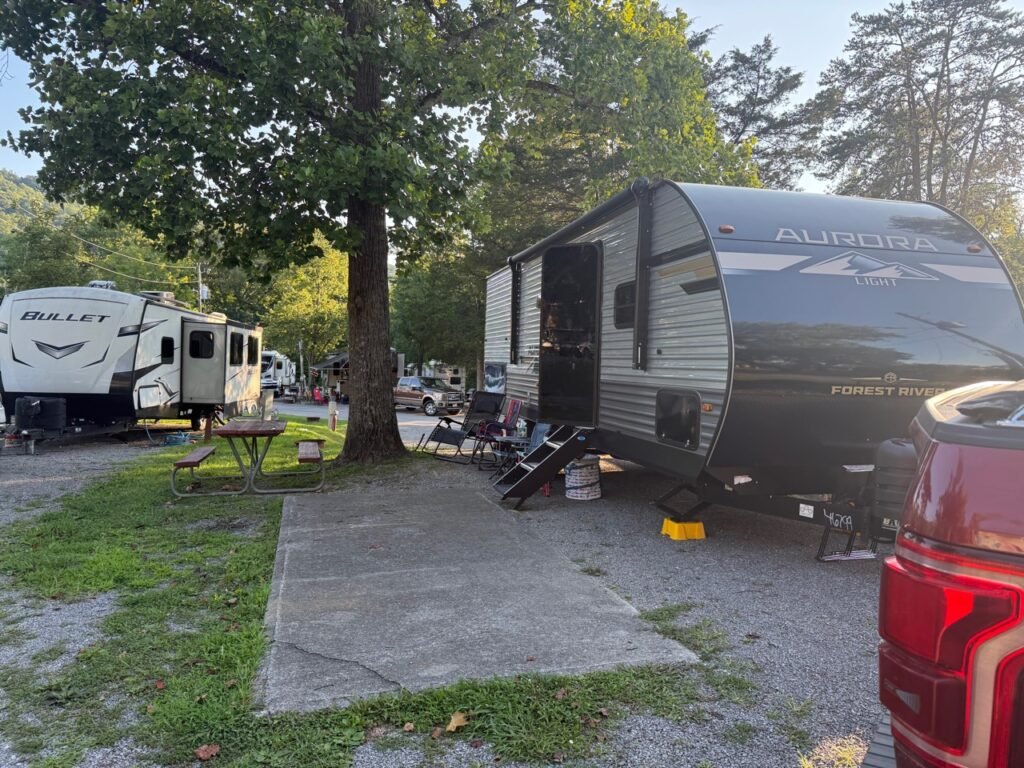
Campground water · our repeatable setup
A small chain of fittings protects the camper—and gives muddy feet somewhere else to go.
Our city-water setup starts with a Y-valve, sends the camper side through a Camco pressure regulator and TastePURE filter, and ends with a 90-degree elbow that keeps the hose from pulling down on the camper inlet.
The short version
Campground water pressure is invisible until it finds a weak point.
A campground spigot can look perfectly ordinary and still deliver more pressure than a camper’s plumbing should receive. The fixtures and water lines inside a travel trailer are compact, lightweight systems. They are not the place we want to test whatever pressure happens to be coming from the campground.
That is why we connect a regulator before water reaches our filter, potable-water hose, or camper. It is the water-side version of plugging our Power Watchdog into the electrical pedestal first: check and control the utility before trusting it with the camper.
Our setup is not complicated. Every part has one job, and the order matters.
Our exact connection chain
Spigot → Y-valve → regulator → filter → potable hose → 90-degree elbow → camper.
Start with the split
The Y-valve gives one campsite spigot two very different jobs.
We attach the Y directly to the campground spigot. The individual shutoffs let us control the camper branch and the utility branch without repeatedly disconnecting the fresh-water setup.
Putting the Y first also means the second branch is intentionally unregulated. That gives us a useful outside hose for short cleanup jobs, but it also means that branch gets the campground’s full pressure. We turn its valve off when we are not actively using it and never connect it to the camper’s fresh-water inlet.


The protective part
The regulator belongs close to the water source.
Camco describes its common fixed brass RV regulator as preset around 40–50 PSI. That range is intended to protect RV plumbing, hoses, fixtures, and appliances from excessive campground pressure.
We place it immediately after the Y on the camper branch. Regulating at the source protects everything downstream—not just the plumbing hidden inside the trailer, but also the filter housing and potable-water hose.
A fixed regulator is simple: there is no gauge to read and no adjustment knob to bump. The tradeoff is that it cannot show the incoming pressure or be fine-tuned. An adjustable regulator with a gauge may be a better choice for someone who wants to see and set the pressure precisely.
Better taste, less sediment
The TastePURE filter improves water; it does not certify the source.
After the regulator, water passes through our Camco TastePURE inline filter. Camco says this style of filter is designed to reduce sediment, chlorine, unpleasant odors, and bad taste. Depending on the exact current version, the media may include granular activated carbon and KDF.
That makes campground water more pleasant and helps catch sediment before it reaches the camper. It does not make a non-potable or microbiologically unsafe source safe to drink. We begin with water the campground identifies as potable and follow the filter’s flushing, storage, and replacement instructions.
We like having the regulator before the filter because the filter never has to absorb raw campground pressure. We also support the filter and connections so their weight is not hanging from the spigot.

A hose with one identity
Potable-water hose means potable-water hose.
Our Camco drinking-water hose is reserved for the fresh-water system. We store it separately, keep the ends capped when possible, and do not lay the connectors where they can pick up dirt or contamination.
Color alone is not the rule—some drinking-water hoses are white, blue, or other colors. The important part is that the hose is specifically rated for potable water and stays dedicated to that job.
The extra hose on the other side of the Y is a utility hose. Keeping those roles separate is one of the simplest ways to avoid cross-contamination.
The small fitting that protects the inlet
The 90-degree elbow removes the downward pull.
A water-filled hose has weight. If we screw the hose directly into the camper, that weight hangs downward and applies leverage to the city-water inlet. People walking past the hose, a tight coil, or a hose shifting on the ground can add even more force.
Our Camco 90-degree elbow changes the direction immediately at the camper. The hose can run downward alongside the wall instead of bending away from the inlet. It is a small, inexpensive fitting that helps protect a much harder-to-repair connection.

Our hookup checklist
We turn the water on slowly and look before walking away.
- Confirm the spigot is potable. We do not assume every campground faucet is intended for drinking water.
- Inspect and briefly flush the spigot. We check damaged threads, debris, and leaks before attaching equipment.
- Attach the Y-valve with both branches closed.
- Build the camper branch: regulator, filter, potable-water hose, then 90-degree elbow at the camper.
- Flush the filter as directed. We do this before connecting the final line to the camper.
- Turn on the camper branch slowly. We check every joint for drips and look inside the camper for leaks.
- Open a faucet briefly. This helps clear air from the line and confirms water is flowing normally.
- Close the utility branch whenever it is not being used.
The second side of the Y
The utility hose earns its storage space.
The unregulated side is there for the campground jobs we do not want to perform with the drinking-water hose.
Because that branch is upstream of the regulator, we treat it like raw campground pressure: the valve stays closed until we are holding the hose and ready to use it. We use a spray nozzle with a shutoff, avoid spraying neighboring sites or campground equipment, and follow local water-use rules.
A separate sanitation system
Why we do not treat the black-tank flush like the fresh-water connection.
The black-tank flush inlet does not feed sinks, showers, or drinking-water lines. It sends water to a rinsing device inside the waste tank, and the tank is vented rather than operating as the camper’s closed pressurized freshwater system. That is why our fresh-water filter and potable-water hose never belong in the black-tank-flush setup.
We use a completely separate, clearly identified non-potable hose for sanitation work. The black-tank drain valve remains open during flushing when the installed system’s instructions require it, and we never leave a tank flush running unattended.
We also use a backflow-prevention device where required and never allow the sanitation hose or fittings to contact potable-water equipment. Separate hoses, separate storage, separate jobs.
Common questions
What this setup does—and does not do.
Does the filter regulate pressure?
No. The regulator controls pressure; the filter reduces certain tastes, odors, chlorine, and sediment. They are separate jobs, which is why the regulator comes first on our camper branch.
Does the filter make any faucet safe to drink from?
No. We only connect to a source designated potable. An inline taste-and-sediment filter is not a universal water purifier.
Why not put the Y after the regulator?
That would regulate both branches, which is a valid setup. We put the Y first because we want a convenient full-flow utility branch and a separately protected camper branch. The tradeoff is that we must actively control the unregulated utility side.
Could the 90-degree elbow leak?
Any extra connection can leak. We use a sound washer, tighten by hand without over-torquing the plastic camper inlet, and inspect it every time the water is turned on.
Do we leave city water on when we leave the campsite?
Our most conservative habit is to shut the campground water off when we will be away for a meaningful period. A regulator reduces risk from excessive pressure, but it cannot stop water from flowing through a hose or fitting that fails downstream.
Our recommendation
Protect the camper, separate the jobs, and remove strain from the inlet.
The regulator protects the plumbing from excessive pressure. The filter improves taste and catches sediment. The potable hose keeps drinking water separate. The elbow protects the inlet from the hose’s downward pull. And the Y-valve gives real campground life—dogs, sand, chalk, and all—its own branch.
None of these pieces is complicated. Together, they give us a repeatable setup that is easier to trust and easier to use.
Sources checked: Camco product information for its brass pressure regulator, TastePURE filter, 90-degree hose elbow, potable-water hoses, and fresh-water Y-valves; Forest River component-manual resources. Last reviewed August 2026.
